
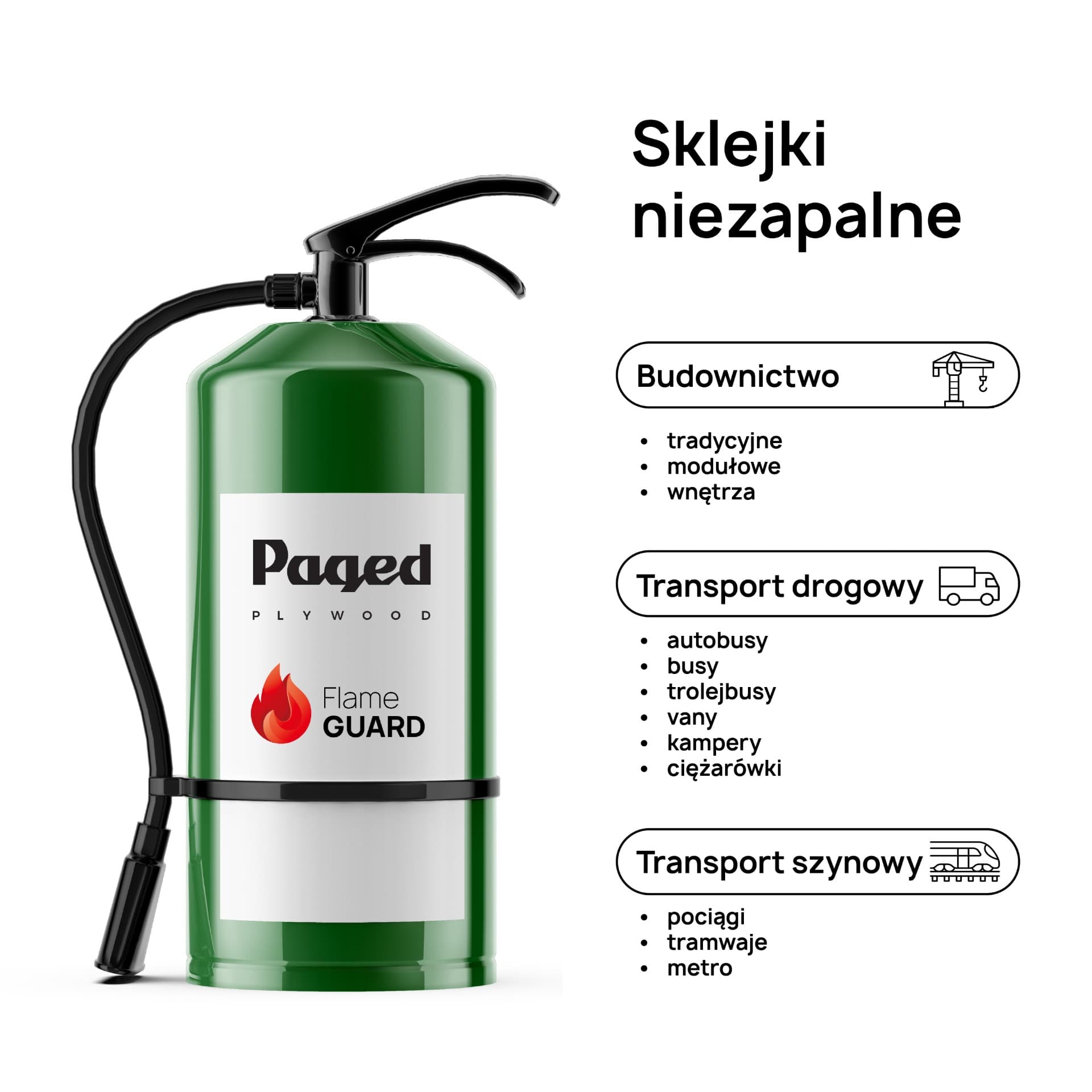
In modern construction, transport, and interior design, FR (fire-retardant) materials are increasingly in focus. This isn't a trend-it's a necessity driven by concern for people's safety and by legal requirements in building and transport regulations. FR plywood combines the functionality of wood with fire-protection properties. As a result, it's used across many sectors-from schools and stations, through HGV semi-trailers, to modular homes and camper vans.
In this article, we explain:
- what FR is,
- what reaction-to-fire classes mean,
- which tests determine them,
- why fire-retardant materials are worth choosing,
- and we present an overview of Paged Plywood's FR panels, which we'll describe in depth in upcoming parts of the "Safer with FR" series.
What is FR?
FR stands for fire retardant. FR plywood is manufactured to:
- slow down fire spread,
- limit smoke generation,
- reduce flaming droplets.
Fire-retardant treatment involves impregnating veneers or finished boards with aqueous fire-protective solutions (most often phosphorus/nitrogen compounds). The most common method is vacuum-pressure treatment in an autoclave; baths and diffusion methods are also used. In practice, FR plywood is safer than standard plywood while preserving the natural benefits of wood-low weight, stiffness, easy machining, and aesthetics.
Reaction-to-fire classes
Reaction to fire is classified under EN 13501-1. The scale ranges from A (non-combustible) to F (no performance determined). Additional designations are used:
- s1-s3 - smoke production (s1 = least, s3 = most),
- d0-d2 - flaming droplets (d0 = none, d2 = many).
This lets architects, designers, and investors match materials to legal and project requirements.
Key designations in practice:
- B-s1,d0 - for walls and ceilings. Very hard to ignite, minimal smoke, no flaming droplets. Crucial in public buildings.
- Bfl-s1 - flooring materials. High fire resistance and limited smoke release, providing more time to evacuate.
- HL1-HL3 (EN 45545-2) - classes used in rail transport. "HL" means Hazard Level. The required class depends on train type and route-HL1 for less critical components, HL3 for high-speed trains and passenger cars where the highest safety level is needed.
How is fire performance tested?
To confirm an FR class, plywood samples are tested by independent laboratories. In practice, two tests are used:
- SBI (EN 13823) - the main building test (feeds into EN 13501-1 classification). Two samples arranged in a corner are exposed to a 30 kW burner, simulating ignition of a single item. The test evaluates fire growth rate, smoke production, and flaming droplets. Based on this, a class such as B-s1,d0.
- Cone calorimeter (ISO 5660-1) - a screening/supporting test (also important in rail, EN 45545-2). A single sample is exposed to a constant heat flux (e.g., 35-50 kW/m²). Time to ignition and rates of heat and smoke release are measured. It's often run first to check whether a sample is likely to pass SBI.
Combining these tests gives a reliable, comparable picture of material behaviour in fire. At Paged Plywood, we perform tests in our Paged LabTech laboratory and in accredited external bodies.
Key fire-test parameters
Abbrev. Name (EN) Unit What does it measure? Why it matters TTI Time to Ignition s Time until ignition The longer, the more time to react/evacuate. HRR Heat Release Rate kW/m² Rate of heat release Indicates fire growth; lower = slower growth. pHRR Peak Heat Release Rate kW/m² Maximum heat release rate Captures peak fire intensity; lower = safer. THR Total Heat Release MJ/m² Total heat emitted Overall "energy" of the fire; lower = better. MARHE Maximum Average Rate of Heat Emission kW/m² Maximum averaged heat emission rate Key for classifications; lower = safer. EHC Effective Heat of Combustion MJ/kg Effective heat of combustion Energy from 1 kg of material; helps assess combustibility. MLR Mass Loss Rate g/s Rate of mass loss How fast the material burns/degrades. SPR Smoke Production Rate m²/s Rate of smoke production Critical for visibility/evacuation; lower = better. TSR Total Smoke Release m² Total smoke produced Affects breathing and visibility; lower = better. CO / CO₂ Carbon monoxide / Carbon dioxide ppm Gas concentrations in effluents Assesses effluent toxicity and human hazard.
Practical note. In FR assessment, TTI (the higher, the better) and HRR/pHRR, THR, MARHE (the lower, the better) are often decisive. Evacuation safety is strongly affected by smoke (SPR/TSR) and gas toxicity (CO/CO₂)-again, the lower, the better. Cone calorimeter results are indicative (screening); building classifications are determined by SBI per EN 13501-1, while rail requirements follow EN 45545-2.
Why is FR plywood crucial?
- Public buildings - in schools, stations, sports halls, and shopping centres, regulations require fire-retardant materials. FR plywood supports compliance and user safety.
- Transport - in HGV semi-trailers, agricultural trailers, or rail cars, fire risk is real. FR materials limit consequences and extend reaction time.
- Interiors & design - decorative FR plywoods combine aesthetics with safety in hotels, offices, and public spaces.
- Campers & modular homes - in mobile/lite structures, low weight and fire protection matter. FR plywood strikes the ideal balance between safety and functionality.
Sustainability
Paged FR plywoods are made from wood sourced from certified forests (FSC®). Choosing wood over metal or plastics lowers lifecycle carbon footprint. Thanks to FR technology, service life is extended-meaning less waste, lower operating costs, and real contributions to a circular economy.
Facts & myths about FR plywood
Does FR plywood not burn at all? No. Any wood can ignite, but FR significantly slows fire growth and reduces smoke.
Is FR plywood harder to machine? No. It can be cut, routed, and bonded like standard plywood. You should, however, check compatibility for planned finishing (lacquering, veneering, laminating) to ensure the finishing system works with the FR treatment.
Is FR plywood much more expensive? It's somewhat more expensive, but it helps avoid costs from design rework or legal non-compliance. It's an investment in safety and durability.
Paged FR plywood overview
Paged offers one of the widest portfolios of fire-retardant plywoods in Europe:
- Softwood ThickPly FR - thick, robust; for structural floors and walls.
- Softwood ThinPly FR - thin and lightweight; ideal for partitions and ceilings.
- BeechPly FR - exceptionally strong; suitable for heavily loaded floors and stairs.
- BirchPly FR - stable and aesthetic; used in furniture, walls, and ceilings.
- Master Form FR - film-faced, smooth; used in formwork and prefabrication.
- Mesh FR - film-faced anti-slip; ideal for floors in heavy transport and public facilities.
- Twin Form FR - versatile for floors and platforms, in smooth or anti-slip variants.
- Phon FR - with a sound-damping layer; for offices, concert halls, and other acoustic spaces.
- DryGuard FR - moisture- and fire-resistant; excellent for modular construction and outdoor use.
Each board has unique properties that we'll detail in the next parts of the series.
Coming next
- September 2025 - Safer with FR #2: FR in traditional and modular construction
- October 2025 - Safer with FR #4: FR in heavy transport
- November 2025 - Safer with FR #5: FR in campers and modular cabins
- December 2025 - Safer with FR #3: FR in interiors & design
- January 2026 - Safer with FR #6: Summary + webinar
Summary
FR plywood meets today's safety and environmental demands in construction, transport, and interior design. It combines the natural advantages of wood with fire protection, and Paged Plywood's broad offering lets you select the right panel for any project-from heavy-duty structures to lightweight mobile fit-outs.